Monday, August 22, 2011

Evaluation - The Ability to Judge the Value of Material for a Given Purpose

Some of the action verbs used to assess evaluation are: appraise, ascertain, argue, assess, attach, choose, compare, conclude, contrast, convince, criticize, decide, defend, discriminate, explain, evaluate, grade, interpret, judge, justify, measure, predict, rate, recommend, relate, resolve. The following are some examples of learning outcomes that demonstrate evidence of evaluation are:
• Assess the importance of key participants in bringing about change in Irish history Evaluate marketing strategies for different electronic business models.
• Summarize the main contributions of Michael Faraday to the field of electromagnetic induction.
• Predict the effect of change of temperature on the position of equilibrium.
• Evaluate the key areas contributing to the craft knowledge of experienced teachers.

Wednesday, August 17, 2011

Analysis - the Ability to Break down Information into its Components

As an example for that we can look for inter-relationships and ideas (understanding of organizational structure). Some of the action verbs used to assess analysis are as follows: analyze, appraise, arrange, break down, calculate, categorize, classify, compare, connect, contrast, criticize, debate, deduce, determine, differentiate, discriminate, distinguish, divide, examine, experiment, identify, illustrate, infer, inspect, investigate, order, outline, point out, question, relate, separate, sub-divide, test. Some examples of learning outcomes that demonstrate evidence of analysis are:
• Analyze why society criminalizes certain behaviors.
• Compare and contrast the different electronic business models.
• Debate the economic and environmental effects of energy conversion processes.
• Compare the classroom practice of a newly qualified teacher with that of a teacher of 20 years teaching experience.
• Calculate gradient from maps in m, km, % and ratio.

Saturday, July 30, 2011

Application - The Ability to Use Learned Material in New Situations

Some of the action verbs used to assess application are shown as follows: Apply, assess, calculate, change, choose, complete, compute, construct, demonstrate, develop, discover, dramatize, employ, examine, experiment, find, illustrate, interpret, manipulate, modify, operate, organize, practice, predict, prepare, produce, relate, schedule, select, show, sketch, solve, transfer, use. Some examples of learning outcomes that demonstrate evidence of application are:
• Construct a timeline of significant events in the history of Australia in the 19th century.
• Apply knowledge of infection control in the maintenance of patient care facilities.
• Select and employ sophisticated techniques for analyzing the efficiencies of energy usage in complex industrial processes.
• Relate energy changes to bond breaking and formation.
• Modify guidelines in a case study of a small manufacturing firm to enable tighter quality control of production.
• Show how changes in the criminal law affected levels of incarceration in Scotland in the 19th century.
• Apply principles of evidence-based medicine to determine clinical diagnoses.

Friday, July 29, 2011

Learning Outcomes and Assessment: Comprehension - Defined as the Ability to Understand and Interpret Learned Information

Some of the action verbs used to assess comprehension are as follows:
Associate, change, clarify, classify, construct, contrast, convert, decode, defend, describe, differentiate, discriminate, discuss, distinguish, estimate, explain, express, extend, generalize, identify, illustrate, indicate, infer, interpret, locate, paraphrase, predict, recognize, report, restate, rewrite, review, select, solve, translate.
Some examples of learning outcomes that demonstrate evidence of comprehension are:
• Differentiate between civil and criminal law
• Identify participants and goals in the development of electronic commerce.
• Predict the genotype of cells that undergo meiosis and mitosis.
• Explain the social, economic and political effects of World War I on the post-war world.
• Classify reactions as exothermic and endothermic.
• Recognize the forces discouraging the growth of the educational system in Ireland in the 19th century.

Thursday, July 28, 2011

Regards from Jevgenija, Latvia

Hi Ana,
I have viewed your blog and tried to leave some comments but somehow could not do that. I think that you have done an excellent work, other teachers can crib and get innovative ideas for their lessons. I also attach some photos of you and us for good memories. Thanks for the photos. Keep in touch, with warm regards, Jevgenija

Wednesday, July 27, 2011

Learning Outcomes and Assessment - Knowledge

Knowledge may be defined as the ability to recall or remember facts without necessarily understanding them. Some of the action verbs used to assess knowledge are as follows:
Arrange, collect, define, describe, duplicate, enumerate, examine, find, identify, label, list, memorize, name, order, outline, present, quote, recall, recognize, recollect, record, recount, relate, repeat, reproduce, show, state, tabulate, tell.
Some examples of learning outcomes for courses in various disciplines that demonstrate evidence of knowledge include the following:
• Recall genetics terminology: homozygous, heterozygous, phenotype, genotype, homologous chromosome pair, etc.
• Identify and consider ethical implications of scientific investigations.
• Describe how and why laws change and the consequences of such changes on society.
• List the criteria to be taken into account when caring for a patient with tuberculosis.
• Define what behaviors constitute unprofessional practice in the solicitor – client relationship.
• Describe the processes used in engineering when preparing a design brief for a client.
Note that each learning outcome begins with an action verb.

Bloom's Taxonomy and Inquiry

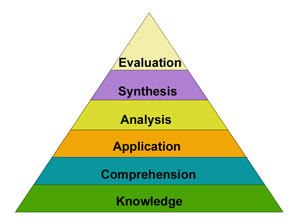
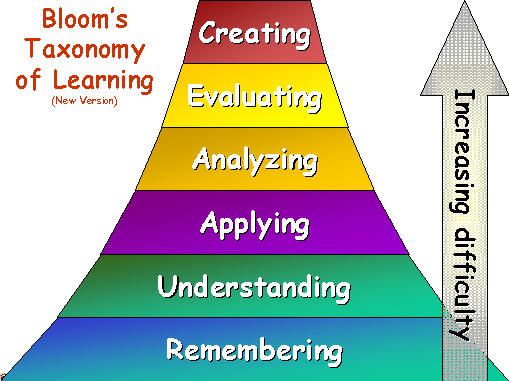
Benjamin Bloom’s taxonomy, updated in 2001, can help you identify and categorize good questions to guide student learning. Within the taxonomy, there are six cognitive levels, and these move from lower- to higher-order thinking. The six levels are remembering (knowledge), understanding (comprehension), applying, analyzing, evaluating, and creating (synthesizing). These six levels provide opportunities for teachers to incorporate inquiry learning into their lessons beyond the lower cognitive-level thinking activities, such as knowledge and comprehension that are centered on recitation and memorization. In order to develop critical thinking and good inquiry activities, you want to ask questions that provide students with opportunities to apply, analyze, synthesize, and evaluate important concepts and themes within the activity. This deeper investigation and exploration of topics allows your students to focus on differentiating and questioning different points of view and then synthesize the information in order to debate an issue or build a model.