 In an activity like problem solving, both kinds of thinking are important to us. First, we must analyze the problem; then we must generate possible solutions; next we must choose and implement the best solution; and finally, we must evaluate the effectiveness of the solution. As you can see, this process reveals an alternation between the two kinds of thinking, critical and creative. In practice, both kinds of thinking operate together much of the time and are not really independent of each other.
Wednesday, September 28, 2011
Critical and Creative Thinking Processes
Much of the thinking done in formal education emphasizes the skills of analysis--teaching students how to understand claims, follow or create a logical argument, figure out the answer, eliminate the incorrect paths and focus on the correct one. However, there is another kind of thinking, one that focuses on exploring ideas, generating possibilities, looking for many right answers rather than just one. Both of these kinds of thinking are vital to a successful working life, yet the latter one tends to be ignored until after college. We might differentiate these two kinds of thinking like this:
 In an activity like problem solving, both kinds of thinking are important to us. First, we must analyze the problem; then we must generate possible solutions; next we must choose and implement the best solution; and finally, we must evaluate the effectiveness of the solution. As you can see, this process reveals an alternation between the two kinds of thinking, critical and creative. In practice, both kinds of thinking operate together much of the time and are not really independent of each other.
In an activity like problem solving, both kinds of thinking are important to us. First, we must analyze the problem; then we must generate possible solutions; next we must choose and implement the best solution; and finally, we must evaluate the effectiveness of the solution. As you can see, this process reveals an alternation between the two kinds of thinking, critical and creative. In practice, both kinds of thinking operate together much of the time and are not really independent of each other.

Friday, September 2, 2011
Synthesis - The Ability to Put Parts Together
Some of the action verbs used to assess synthesis are the following: argue, arrange, assemble, categorize, collect, combine, compile, compose, construct, create, design, develop, devise, establish, explain, formulate, generalize, generate, integrate, invent, make, manage, modify, organize, originate, plan, prepare, propose, rearrange, reconstruct, relate, reorganize, revise, rewrite, set up, summarize. Some examples of learning outcomes that demonstrate evidence of synthesis are: 1) Recognize and formulate problems that are amenable to energy management solutions; 2) Propose solutions to complex energy management problems both verbally and in writing; 3) Summarize the causes and effects of the 1917 Russian revolutions; 4) Relate the sign of enthalpy changes to exothermic and endothermic reactions; 5) Organize a patient education program. Note that the verbs used in the above six categories are not exclusive to any one particular category. Some verbs appear in more than one category. For example, a mathematical calculation may involve merely “applying” a given formula or it may involve “analyzing” as well as ‘application’.
 Some examples of learning outcomes that demonstrate evidence of synthesis are: 1) Recognize and formulate problems that are amenable to energy management solutions; 2) Propose solutions to complex energy management problems both verbally and in writing; 3) Summarize the causes and effects of the 1917 Russian revolutions; 4) Relate the sign of enthalpy changes to exothermic and endothermic reactions; 5) Organize a patient education program. Note that the verbs used in the above six categories are not exclusive to any one particular category. Some verbs appear in more than one category. For example, a mathematical calculation may involve merely “applying” a given formula or it may involve “analyzing” as well as ‘application’.
Monday, August 22, 2011
Evaluation - The Ability to Judge the Value of Material for a Given Purpose
 Some of the action verbs used to assess evaluation are: appraise, ascertain, argue, assess, attach, choose, compare, conclude, contrast, convince, criticize, decide, defend, discriminate, explain, evaluate, grade, interpret, judge, justify, measure, predict, rate, recommend, relate, resolve. The following are some examples of learning outcomes that demonstrate evidence of evaluation are:
• Assess the importance of key participants in bringing about change in Irish history Evaluate marketing strategies for different electronic business models.
• Summarize the main contributions of Michael Faraday to the field of electromagnetic induction.
• Predict the effect of change of temperature on the position of equilibrium.
• Evaluate the key areas contributing to the craft knowledge of experienced teachers.
Wednesday, August 17, 2011
Analysis - the Ability to Break down Information into its Components
 As an example for that we can look for inter-relationships and ideas (understanding of organizational structure). Some of the action verbs used to assess analysis are as follows: analyze, appraise, arrange, break down, calculate, categorize, classify, compare, connect, contrast, criticize, debate, deduce, determine, differentiate, discriminate, distinguish, divide, examine, experiment, identify, illustrate, infer, inspect, investigate, order, outline, point out, question, relate, separate, sub-divide, test. Some examples of learning outcomes that demonstrate evidence of analysis are:
• Analyze why society criminalizes certain behaviors.
• Compare and contrast the different electronic business models.
• Debate the economic and environmental effects of energy conversion processes.
• Compare the classroom practice of a newly qualified teacher with that of a teacher of 20 years teaching experience.
• Calculate gradient from maps in m, km, % and ratio.
Saturday, July 30, 2011
Application - The Ability to Use Learned Material in New Situations
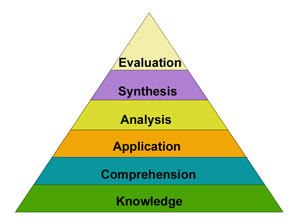 Some of the action verbs used to assess application are shown as follows: Apply, assess, calculate, change, choose, complete, compute, construct, demonstrate, develop, discover, dramatize, employ, examine, experiment, find, illustrate, interpret, manipulate, modify, operate, organize, practice, predict, prepare, produce, relate, schedule, select, show, sketch, solve, transfer, use. Some examples of learning outcomes that demonstrate evidence of application are:
• Construct a timeline of significant events in the history of Australia in the 19th century.
• Apply knowledge of infection control in the maintenance of patient care facilities.
• Select and employ sophisticated techniques for analyzing the efficiencies of energy usage in complex industrial processes.
• Relate energy changes to bond breaking and formation.
• Modify guidelines in a case study of a small manufacturing firm to enable tighter quality control of production.
• Show how changes in the criminal law affected levels of incarceration in Scotland in the 19th century.
• Apply principles of evidence-based medicine to determine clinical diagnoses.
Friday, July 29, 2011
Learning Outcomes and Assessment: Comprehension - Defined as the Ability to Understand and Interpret Learned Information
 Some of the action verbs used to assess comprehension are as follows:
Associate, change, clarify, classify, construct, contrast, convert, decode, defend, describe, differentiate, discriminate, discuss, distinguish, estimate, explain, express, extend, generalize, identify, illustrate, indicate, infer, interpret, locate, paraphrase, predict, recognize, report, restate, rewrite, review, select, solve, translate.
Some examples of learning outcomes that demonstrate evidence of comprehension are:
• Differentiate between civil and criminal law
• Identify participants and goals in the development of electronic commerce.
• Predict the genotype of cells that undergo meiosis and mitosis.
• Explain the social, economic and political effects of World War I on the post-war world.
• Classify reactions as exothermic and endothermic.
• Recognize the forces discouraging the growth of the educational system in Ireland in the 19th century.
Thursday, July 28, 2011
Regards from Jevgenija, Latvia
 Hi Ana,
 I have viewed your blog and tried to leave some comments but somehow could not do that. I think that you have done an excellent work, other teachers can crib and get innovative ideas for their lessons. I also attach some photos of you and us for good memories. Thanks for the photos. Keep in touch, with warm regards, Jevgenija
Subscribe to:
Posts (Atom)